Project Overview
This interactive website visualizes satellite data to provide insights into the global landscape of artificial satellites. Created as a project for my Data Visualization course, it uses Python with Pandas for data processing and Plotly for interactive visualizations. The data is sourced from Jonathan's Space Report (satcat) link and shows various aspects of satellite distribution across sectors, countries, and time.
Satellites have become an integral part of modern society, enabling global communications, weather monitoring, navigation systems, and scientific research. This project aims to showcase the growth and distribution of satellite technology across different sectors and countries throughout history.
Dominant Players
The United States leads with over 23,350 satellites, followed by Russia (9,029) and China (8,536). SpaceX alone has launched more satellites in the last 5 years than the rest of the world combined over the previous 50!
Sector Evolution
There's been a dramatic shift from military dominance in the early space age to commercial leadership today. The visualization shows how commercial satellites have grown to become the largest sector.
Global Reach
30 countries have successfully launched satellites, with recent entrants including the UAE, Indonesia, and New Zealand. This demonstrates the growing democratization of space technology.
Satellite Data Infographic
This infographic provides a comprehensive overview of the global satellite landscape, including leading launch nations, top satellite operators, and satellite ownership distribution by sector across different decades. The entire website and all interactive visualizations presented here are based on and inspired by this infographic, which serves as the foundation for our data exploration.
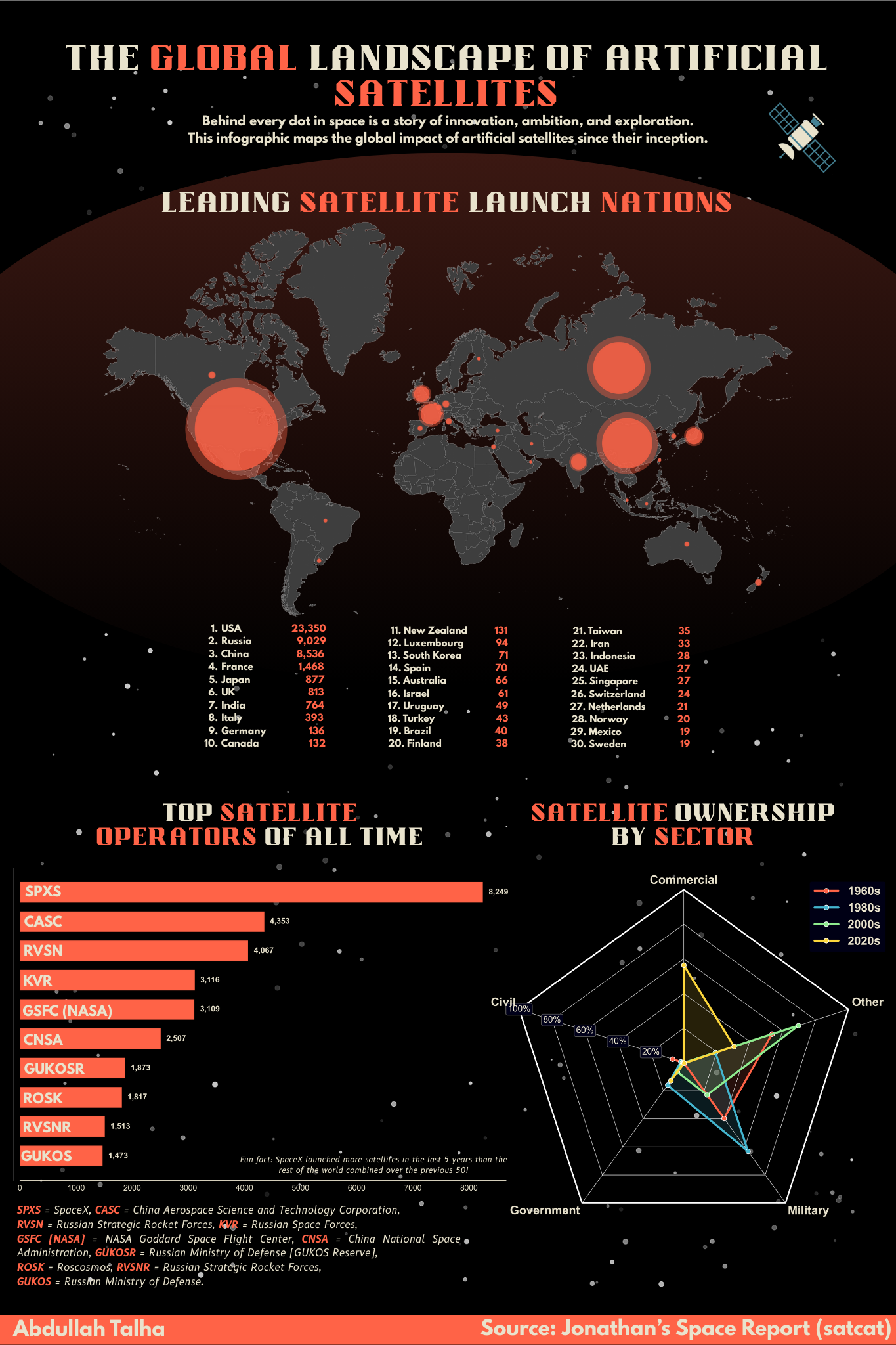
The infographic shows the dominance of the United States in satellite launches, with 23,350 satellites, followed by Russia and China. It also highlights how SpaceX has become the leading satellite operator with 8,249 satellites in orbit.
Download Infographic
Satellite Sector Distribution
This visualization shows how satellite ownership has evolved across five main sectors: Commercial, Government, Military, Civil, and Other. The interactive polar chart demonstrates the dramatic shift from military dominance in the early space age to commercial leadership today.
Commercial
Companies like SpaceX dominate this sector with constellations like Starlink. The commercial segment has seen explosive growth in recent years.
Government
Government agencies like CASC (China) and ROSK (Russia) operate satellites for national interests and civil applications.
Military
Military entities like RVSN (Russian Strategic Rocket Forces) and US Air Force operate satellites for defense and intelligence purposes.
Civil
Civil space agencies like NASA operate satellites for scientific research, Earth observation, and space exploration.
Leading Satellite Launch Nations
This interactive map visualization shows the geographical distribution of satellite launches across countries. The size of each bubble represents the number of satellites launched by that country. The United States, Russia, and China are the top three nations by a significant margin.
United States
Leading with 23,350 satellites, the US has maintained its dominance in space through NASA, military programs, and commercial ventures like SpaceX.
Russia
With 9,029 satellites (including Soviet-era launches), Russia continues to be a major space power despite economic challenges.
China
Rapidly growing its space presence with 8,536 satellites, China has ambitious plans for lunar exploration, space stations, and more.
Top Satellite Operators of All Time
This section highlights the organizations responsible for operating the largest number of satellites. SpaceX leads by a significant margin, demonstrating the growing role of commercial entities in space.
Fun fact: SpaceX launched more satellites in the last 5 years than the rest of the world combined over the previous 50!
Satellite Launches Timeline
This interactive timeline visualization shows the cumulative growth of satellite launches by the top 10 countries over time. It demonstrates how the space race has evolved since the launch of Sputnik in 1957.
Key Milestones
1957: Sputnik 1 (Soviet Union) - First artificial satellite
1958: Explorer 1 (United States) - First US satellite
1970: First Chinese satellite Dong Fang Hong I
2020-Present: Explosive growth led by SpaceX's Starlink constellation